Cutting to Size
-
CAUTION: A cool air mist
should be in contact with the blades of all cutting devices
before and during penetration of the plastic. Wear appropriate
protective gear such as a facemask, goggles, and gloves.
- Scribing and Breaking:
This method is used to achieve a quick, straight line cut of
single sheets of acrylic mirror less than 3mm (1/8") thick. Mark
the line to be scribed (scored) on the mirror
with a commercial scriber. Firmly place a straight edge along the line and use it as a guideline for the scriber or knife. Scribe the mirror along the line using several firm, evenly pressured
strokes. Then, overhand the end of the mirror off the work table. Break the mirror with sharp downward pressure.

- Circular Table And Panel Saw
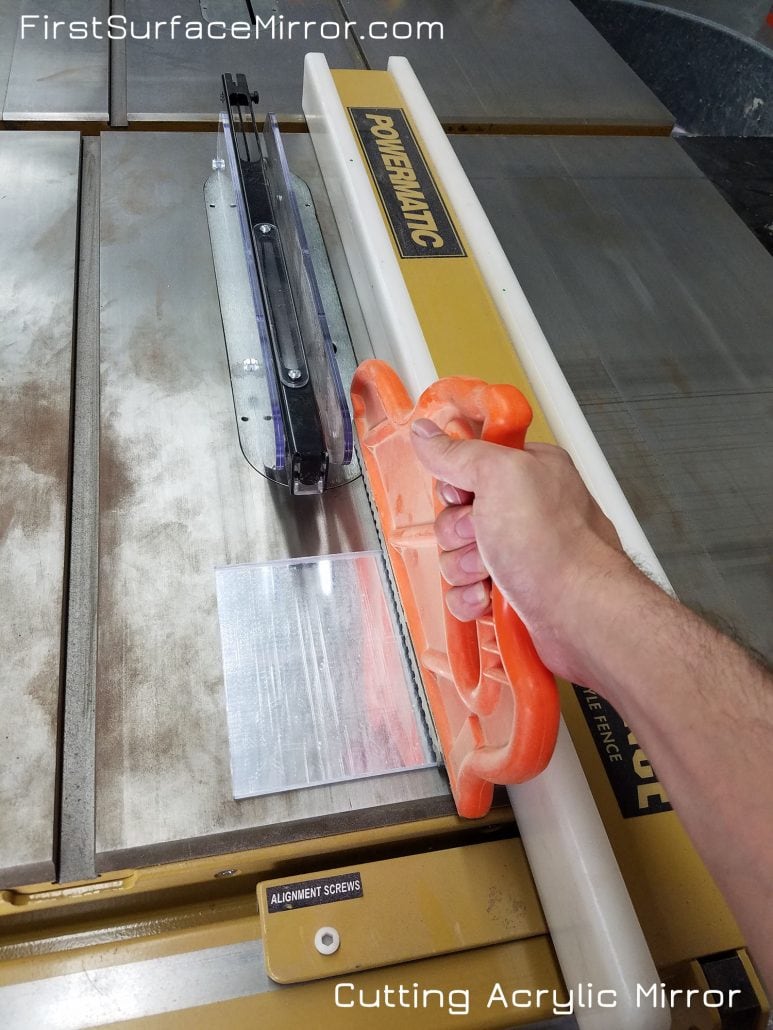
Cutting: These saws are used to achieve a precise, straight
line cut of one or more mirrors. Because vibration is minimal,
this method of cutting is recommended. The best way to avoid
vibration and unwanted runout is to install a stiffener 1/2 to
2/3 the saw blade diameter and mount it against the outside of
the blade. To prevent back cutting, the saw arbor, the saw table
and the table fence must be properly aligned. Also, the throat
plate (table kerf) must be kept to a minimum. A 10", 80 tooth
carbide tipped blade is recommended for all-purpose cutting. The
blade's teeth should be the triple-chip design, where every
other tooth has a
beveled cutting edge to help clear away saw chips,. For best results, the teeth should have a clearance angle of 10 to 15". Material should be cut with masked side down. Any paper interleaf should be kept intact between sheets to protect paint back coat during cutting.
Use enough power to make the needed cuts, using a smooth and even feed rate. Uneven feed rates may produce gumming or chipping of the mirror.

- Saber Saw Cutting: Saber
saws are generally used for cuts involving a frequent change in
direction. Maintaining adequate support is important to prevent
vibration which may cause chipping. To achieve this,
clamp a straight board on the sheet near the cutting line. This may also be used as a saw guide. Set the saw to full speed before cutting the mirror. Without feeding too fast, press the saw shoe firmly against the mirror while cutting. Blades for saber saws should have at
least 14 teeth per inch. - Jig Saw Cutting: Jig saws should be used primarily for inside cuts and intricate letters. Since the stroke is short, the blade heats up quickly and tends to soften and fuse the mirror. To avoid this, a fast and steady feed rate." Blades for jig saws should have at least 14 teeth per inch.
- Band Saw Cutting: Band saws are used for cutting curved sections or trimming band saws should have at least 10 teeth per inch.
- Laser Cutting: Lasers may
be used to cut virtually any image on a mirror with minimal
material waste. The CO2 laser operates by focusing a large
amount of energy on a small defined area and melting and
vaporizing the material. It produces a clean, polished edge
without any saw chips. An average of 200 inches per minute may
be accomplished by using about 200 watts from a 1200 watt laser.
Annealing the sheet is recommended after cutting, especially
when cementing is anticipated. Caution: lasers can create
stresses along cut areas. Be sure to use a
test piece before fabrication. - We sell custom size mirrors if you would prefer to have it cut for you. Please contact us with your size in inches or centimeters for further details. The price is generally $10 more than the cost of the next biggest mirror. The largest size we can cut is 48"x96". If you need to cover a larger area than that, you can buy two mirrors and use them side-by-side.
- The mirror is protected by a removable, clear plastic coating on one side. Don't pull it off before cutting, because you want that side protected. We suggest that you protect other side as well, with plastic (seran wrap), before doing any cutting. Use carpet tape to tape over the area where you plan to cut the mirror. Do NOT tape the coated side, because when you pull it off, the mirror will stick to the tape and be removed. Taping the other side is fine. You will want to use a tape that does not leave a residue.
- Measure and draw the cut-line on the tape. You will be cutting through the tape. This will help protect the acrylic surface from getting scratched.
- It helps to use a table stop or guard when cutting straight lines.
- Feed the acrylic through the cutting blade slowly. If you feed too quickly, there is a risk of the teeth catching the acrylic and breaking out small areas. The general rule is don't force the cutting speed. Note that this is especially true when using a table saw or jigsaw. Rip saw blades do not work well. If possible, use a fine tooth blade on a table saw or jig saw.
- When you have finished cutting, check the size before removing the tape. If it is correct you can use a sanding block or belt sander to smooth the edge. This step is optional, especially if you plan to frame the mirror.
- Don't remove the tape and protective clear plastic coating until you're ready to mount the mirror. This will minimize the chance of it being scratched.
Drilling
The mirror may be easily drilled with any commercial power-driven drill available. Included are: Portable drills, drill presses, lathes, or automatic multiple-spindle drilling units.
Before drilling a hole in a mirror, it is recommended to use a bit offered especially for plastics. If a drill bit for plastics is not available, a metal-working drill bit with a high -speed twist may be used with some modification.
Because metal-working drill bits are designed to push through metal the following modifications must be made to ensure
no chipping or other damage to the mirror:
1. The tip angle is usually about 120 degrees, this is too flat to cut through the mirror
products without damage and must be ground to a sharp angle of 60-90 degrees to allow the bit to
enter and exit easily without chipping.
2. The cutting edge must be ground to a rake angle of 0-4 degrees. This "flat" cutting edge will scrape
the mirror without gouging it.
3. The surface behind the cutting edge must be ground away to clearance angles of 12-15 degrees. This will allow back relief for reduced metal to plastic contact and heat build up.Drill bits with tips larger than 5/8" should be ground to a point to reduce the amount of force required to start a hole.
Drill bits must be true, or melting, burning and chipping may occur. Correctly modified drill bits will create two continuous spiral strips as the bit passes evenly through the mirror, when operated at the proper speed.When drilling the actual mirror it would be wise to back up the surface with a durable surface, such as
plywood, so the drill bit will continue into a solid material, this will prevent chipping on the opposite side of the
mirror. A slow feed rate should be used when the bit enters or exits the mirror.Holes of 1" or more may be cut with a circle cutter. To accommodate the material properties of mirror, the
cutter bit must be modified so the tip scrapes the material without gouging it. Use a cool air mist system to avoid heat
build up, leaving the walls of the hole with a smoother cutting edge. Use a drill press for uniform pressure and
constant vertical positioning.
RoutingMany routers are available for use in the fabrication process. The router should have a minimum of one horse-power
and a no load speed of about 20,000 RPM. Routers are normally used with a single or double fluted bit, but may
consist of one to four flutes. Router bits can be carbide tipped, high-speed steel, solide carbide, or diamond tipped.
They may be one piece piloted, non-piloted, straight cutting, multiple part, forming or specialty bits."Hand Routing: A hand router is generally used when making a prototype or a replacement part, by using a
precut template pattern clamped to the mirror, the hand held router may be
smoothly guided around the pattern. Move clamps whenever necessary."Circle Routing: A circle router would be used when a 360 degree piece of the mirror is needed."
Pin Routing: Pin routers are very flexible. A double-backed tape or vacuum holds the mirror in place. Using
the mounted overarm router to hold the cutter over a guide pin in the table, feed the mirror and pattern into the cutter and rotate 360 degrees to form finished product."Contour Routing: By using a contour jig on a pin routing machine, multiple parts can be manufactured. Cut the
desired pattern on the base of the jig to follow the base guide pin. To secure several mirrors at one time, clamps should be mounted on the top of the work. Be sure to raise and
lower clamp holders as necessary when the jig is rotated."Computerized CNC routers are used in the manufacture of high volume production. This type of router is
Numerical Control designed for maximum use of the mirror. Mirrors may be designed for stacking
(CNC) Routing: which eliminates much of the waste normally produced."Direction of Travel: This router is designed to rotate counterclockwise for external cuts, and clockwise for routing
the inside edges of the mirror. When properly fed in the direction necessary, a smooth cut will result.When operating a router, several precautions are necessary to avoid mistakes to the mirror or the tool in use. First routers are designed with a small diameter and must be operated at high speeds. Avoid vibrations, even the slightest vibration can cause crazing and fractures in the mirror during routing. Second, watch RPM speeds, higher RPM rates allow for faster feeding of the mirror, resulting in a smoother finish. Recommended RPM speeds are 18,000 to 28,000 RPM. Third, for maximum production, operate the feed rate just below chipping speed. Do not overload the motor. Fourth, maintaining a sharp cutter is very important to avoid chipping and decreased production. Finally, use a 1/2" or larger diameter cutter whenever possible, this larger diameter provides a better surface with less tendency to chip."
Edge and Surface FinishingThe extent of finishing needed to produce a smooth, transparent edge is based upon the quality of the cutting
tool used to machine the edge. A properly designed cutting tool with a sharp cutter will reduce the amount of finishing needed. Finishing is also reduced when a spray coolant is used along with the cutting tool to reduce excess heat build-up.Polishing: A polished edge is the best possible finished edge, but requires the most preparation. Prior sanding is necessary if the edge is shaped from a saw-cut, sanding is not necessary when there is a well milled edge. A jointer, shaper, or hand-scraped edge can be used in place of sanding. A stationary polishing head produces the best polished surface. Bleached muslin wheels with a diameter of 8" to 14" with bias strips is recommended. This gives the buffing wheel a pleated appearance, and runs cooler than a stitched buffing wheel design and will also do a fast job.
Polishing Compounds: The finished quality of the polished edge is determined by the polishing compound used. To produce a high luster finish, the use of a fast cutting compound first will remove all sanding marks, followed by a high luster compound for the final buffing. To achieve a fairly good finish in one operation, a medium cutting compound would be best.
Polishing Surface: Prior sanding is not necessary when the scratches or machining marks are not too deep. A
surface polishing wheel should be from 6" to 12" in diameter, built up to a width for 1 1/2" to 2". For the initial polish, use a soft, bleached muslin wheel, followed by a soft flannel wheel
for the finishing.Depending on the depth of the scratches, use a medium-course polishing compound or a fine compound. Be sure to keep the mirror in motion at all times during the polishing procedure.
Questions? Call us! (419) 842-4554